With AI adoption moving beyond simple chatbot use cases to more complex agentic workflows, engineering teams are having to find new patterns for building systems. Most agents are initially developed to do one thing, then more tools get bolted on, more responsibility, more context, until a single agent is handling your order placement, inventory and payment processing all at once
That’s the monolithic agent pattern and it’s the same mistake we made with monolithic applications a decade ago, just with prompts instead of code.
Understanding the Agent-as-Tool Pattern
The fix is pretty straightforward to say, but hard to build well: separate out concerns and give each agent one job. Instead of relying on a single agent trying to do everything, you build several small autonomous agents, each scoped to a single task, and let a top-level orchestrator agent call them the same way it’d call any other tool.
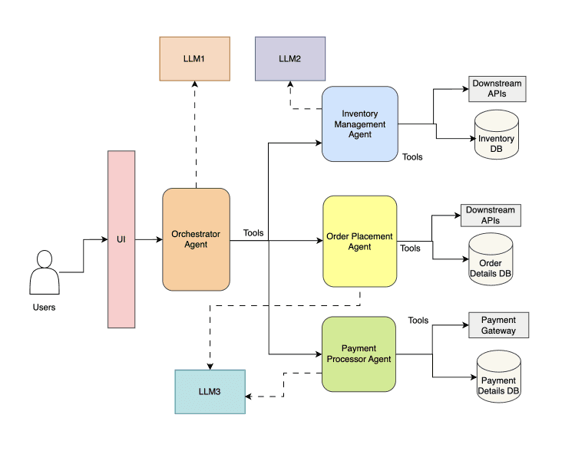
To the main orchestrator, each sub-agent exposes a clean, schema-defined tool contract (accepting structured inputs and returning a structured response). But behind that simple tool invocation exists an entire isolated environment containing:
- A Specialised System Prompt: Built exclusively for a single task (e.g. inventory checking, order placement, payment processing, etc.).
- Domain-Specific Sub-Tools: Private API connectors, local execution sandboxes, or database readers that the orchestrator agent never directly needs to access. (e.g. only the payment processing sub-agent will have access to payment gateway endpoint)
- Dedicated Context & Runtime: An isolated context window and execution sandbox running in a managed runtime.
Key Benefits of the Agent-as-Tool Architecture
1. It separates concerns
In monolithic setup, every step of an agent’s internal monologue and tool execution history accumulates in a single context window. With Agent-as-Tool, all of that intermediate reasoning, raw API responses, and retry loops remain completely isolated inside the sub-agent’s lifecycle. The orchestrator only sees the final, curated answer, which keeps it performant and easier to reason about.
2. You gain model flexibility
Different jobs demand different model capabilities. Your sub-agents can use different LLM models based on the requirements of the task, for example you can use a cheaper and faster model on a simple lookup and save the more expensive models for a complex task that requires it.
3. Reduced complexity
Standard protocols like MCP effectively turn sub-agents into reusable components that can be used across multiple orchestrators.
4. It’s easier to govern and secure
Giving one large agent blanket access to all internal tools poses significant risk. Packaging capabilities into sub-agents establishes hard security boundaries. For example, only the payment processing sub-agent will have an integration with the payment gateway endpoint.
Key Design Principles for Production
While implementing the Agent-as-Tool pattern in production environments, you should consider the following points:
- Cap the call depth: Without a limit you can end up with Agent A calling Agent B calling Agent A. Avoid the risk of recursion by capping call stacks to 2-3 levels.
- Define structured output contracts: Sub-agents should return predictable, structured responses (e.g. JSON Schema or Pydantic models) to ensure that the orchestrator can easily parse it.
- Implement timeouts and fail gracefully: Set strict execution timeouts on sub-agent tool calls. If a sub-agent fails to resolve its loop, it should yield a structured error state so the orchestrator can decide whether to retry or escalate.
- Use Managed Runtimes: Deploy sub-agents into serverless runtimes such as Amazon Bedrock AgentCore, or containerized microservices, gets you automatic scaling, isolated execution, and security controls without building all of that yourself.
SUMMARY
The Agent-as-Tool architectural pattern marks an essential shift in AI system design – moving away from monolithic, all-knowing prompts toward modular, specialized, and composable agent networks. By treating sub-agents as discrete tools, platform teams can build agentic applications that are easier to test, safer to govern, and far more resilient in production.