Enterprises are heavily investing in AI agents to accelerate projects and achieve their business goals. These agents are autonomous software systems that utilise AI (LLM models) to understand their ecosystem, learn and adapt to meet the desired goals. The models used in these systems are often extremely powerful, yet they sometimes lack proper context and access to the data, thereby limiting their effectiveness.
In November 2024, Anthropic open-sourced the Model Context Protocol (MCP). It is their homegrown, open standard for connecting AI systems to data trapped in silos and legacy systems using a single protocol, which otherwise would have required custom integration, rendering the system difficult to scale effectively.
Let’s discuss what the MCP really is and the effect it can have on how you approach AI-based projects.
Problem and Solution
Before MCP, connecting AI models to data sources was complex, inefficient, and risky. For example, connecting N AI tools to M data sources created NxM complex, individual connections, resulting in:
- Wasted Hours: Developers wrote repetitive boilerplate code for each integration.
- Security Risks: Sensitive data often had to be moved to the cloud just for AI access.
- Fragility: A simple API change could break all associated connections, causing system failures.
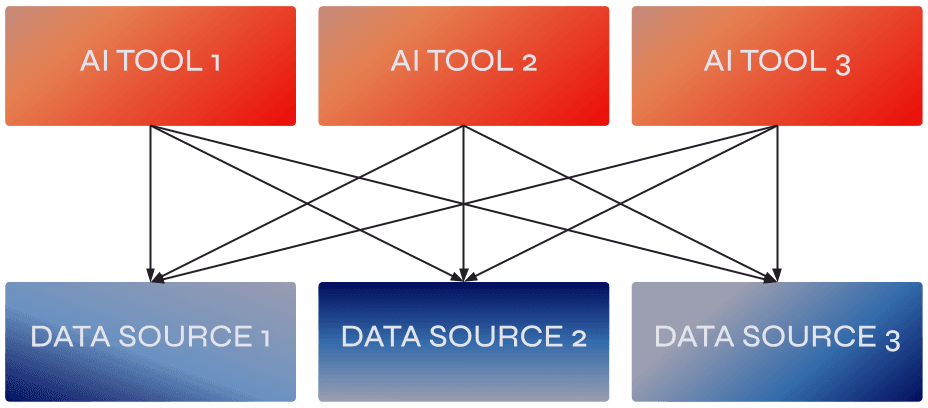
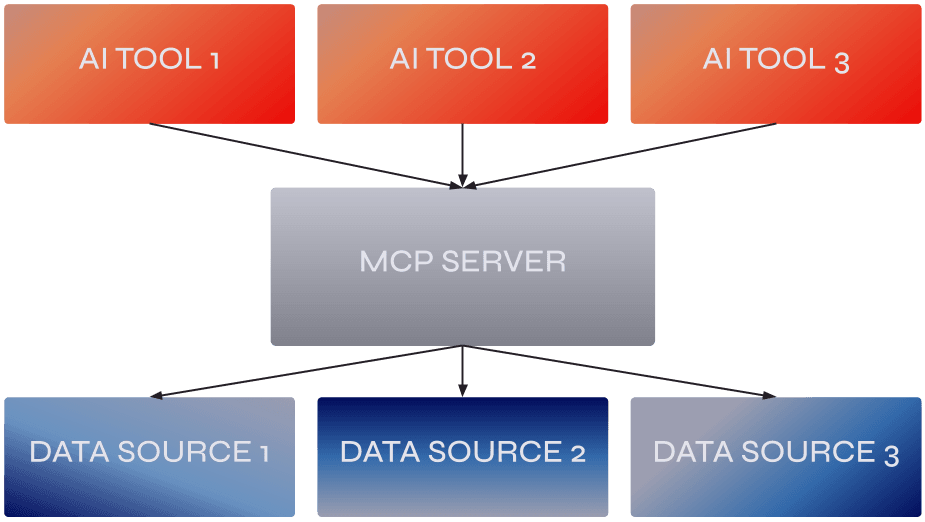
MCP introduces a Host-Server architecture, which standardises how an AI application interacts with data. Now, for connecting N AI tools to M data sources, you no longer need to build NxM custom bridges. Rather, you build one MCP Server for your data. Any MCP Host (like Claude Desktop, Cursor, or an IDE) can then plug into that server instantly. That narrows down to N+M connections.
Architecture
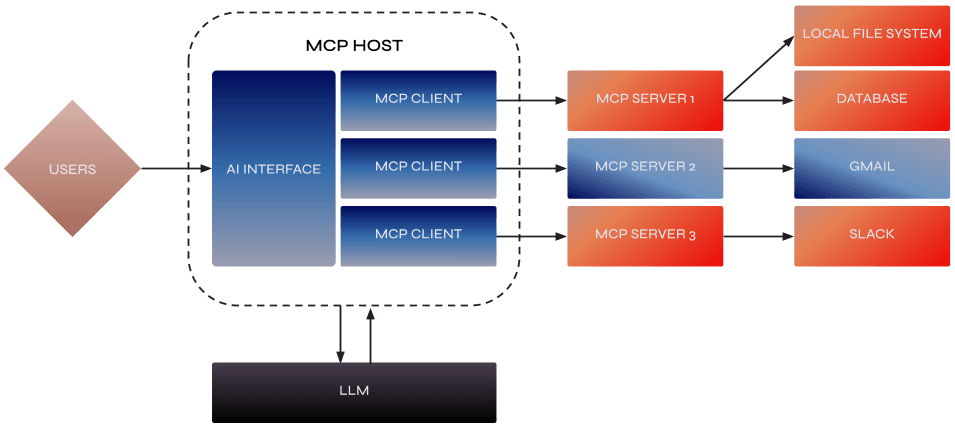
The major components of MCP are:
- MCP Host: The user-facing AI application/tool that communicates with an AI model and manages one or multiple MCP clients. Example – ClaudeDesktop, Cursor, VSCode, etc.
- MCP Client: The code that acts as a connector to an MCP server, maintaining the bridge (over protocol like JSON-RPC) between Host and Server. Example – IDE extension, CLI tool, etc.
- MCP Server: A lightweight program that abstracts a data source or tool (a codebase, a database, a workspace, etc.), providing context to MCP clients. Example – GitHub MCP Server, Slack MCP Server, etc.
Primitives of MCP Servers
In the MCP ecosystem, servers offer the essential building blocks or primitives to build the connectors between the language model and your data. There are three primitives:
- Prompts: The interactive pre-defined templates that steer the model’s behaviour.
- Resources: The knowledge library that provides read-only context, such as local file, API documentation or database records.
- Tools: These are the action modules, executable functions that allow the models to interact with the real world and tasks like updating a codebase, triggering a build, etc.
Why is MCP a Game Changer?
- Secured Data Access: With MCP, the data resides in the place it belongs. The AI model accesses the data to grab the context it needs for a specific task, but does not use it to train itself. This provides enterprise priority.
- Transform Chatbots to Agents: MCP enables AI agents. With the help of tools, now your application can check a Jira ticket, trigger a code build pipeline and send an email – all over a single protocol.
- Flourishing Ecosystem: The community has grown extensively and has built a vast library of MCP Servers, covering the world’s most popular software.
How is MCP different from RAG?
You might doubt how MCP differs from Retrieval-Augmented Generation (RAG).
RAG improves LLMs by incorporating current, relevant data from external knowledge bases before generating a response. This process helps minimise hallucinations and boosts the reliability of the model’s output.
In a RAG architecture, the data must be pre-processed or chunked and stored in a vector database, which thereby limits the model to referencing a snapshot of the information that can become stale.
In contrast, MCP represents an active integration layer to your models. Instead of relying on a vector database of indexed texts, MCP provides a direct bidirectional bridge between your model and the data sources. It empowers your AI application with tools to execute workflows.
The modern agentic system uses a combination of both RAG and MCP. A typical example is a sophisticated AI agent of an e-commerce enterprise that uses RAG to understand the company policy about issuing refunds to customers and then uses MCP tools to initiate refunds in the payment processor.
Operational Evaluation: Pros and Cons
Advantages
Real-time data access: Models can access live data without any latency and need for chunking.
- Local-First Security: The model only sees the specific context required for the prompt, which is exposed through primitives. The data sits securely within your purview.
- Ecosystem Scalability: Utilise a growing library of open-source servers for Postgres, Google Drive, and more, without the need to write custom API logic.
Considerations
- Infrastructure Management: Organisations must manage the lifecycle and uptime of MCP servers as they would any other microservice.
- Security Guardrails: Providing the model with “Tools” (Read/Write access) requires robust permission sets and human-in-the-loop oversight to prevent unintended actions.
- Latency: If your MCP Server is hosted remotely, every tool call may incur network latency. Sometimes, if your server has multiple tools, it gets token-heavy for executing the Model with larger prompts.
The Model Context Protocol represents a shift from “AI as a destination” to “AI as an integrated layer” within your software stack. By standardising the way models access context and execute tools, MCP enables developers to build more capable, secure, and actionable AI applications while reducing the heavy lifting of custom integrations.
For those looking to get started, the open-source community has already provided a vast array of pre-built servers, allowing you to plug your existing data into the next generation of AI hosts immediately.

Saborni Bhattacharya
Lead Cloud Consultant, Scale Factory